

Our Blogs
The Critical Role of EV Pre-Charge Resistors in High-Voltage System Safety
Summary: This article explores the fundamental necessity of EV Pre-Charge Resistors in safeguarding the delicate electronics of electric vehicles. We examine how specialised components, including Aluminium Housed Wire Wound Resistors and the CCT series, provide essential protection against high-current surges. By managing the energy flow into DC bus capacitors, these resistors prevent component failure and ensure the long-term reliability of the entire high-voltage powertrain.
Core Solution: EV Pre-Charge Resistors protect high-voltage systems by limiting the initial inrush current during startup, allowing capacitors to charge gradually and preventing permanent damage to contactors and power electronics.
The shift toward electric mobility has brought high-voltage safety to the forefront of automotive engineering. As vehicles move from traditional internal combustion engines to powerful battery-driven systems, the way we manage electrical energy has fundamentally changed. One of the most vital, yet often overlooked, components in this ecosystem is the pre-charge resistor. Without this small but robust part, the high-voltage system of an electric vehicle would face significant risks every time the driver presses the start button.
When an electric vehicle is activated, the high-voltage battery must connect to the rest of the electrical system, specifically the inverter and motor controller. These systems contain large DC bus capacitors that store energy for smooth operation. However, when a high-voltage battery is directly connected to empty capacitors, it creates a massive spike in current known as inrush current. This surge can be thousands of amperes, which is enough to weld contactors shut, blow high-voltage fuses, or degrade the lifespan of the capacitors themselves.
To mitigate this, manufacturers use EV Pre-Charge Resistors to provide a controlled path for the current. By placing a resistor in a secondary circuit, the system allows the voltage to rise steadily rather than instantaneously. This ensures that the voltage across the capacitors is nearly equal to the battery voltage before the main contactors close.
Technical Excellence in Pre-Charge Design
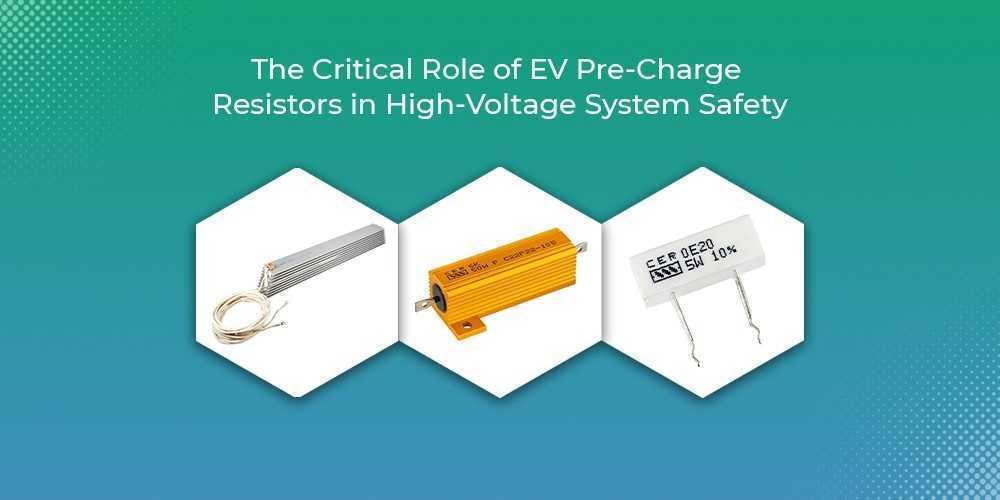
For these high-stakes applications, engineers often turn to aluminium-housed wire-wound resistors. These components are favoured because they offer excellent thermal management and mechanical durability. In an electric vehicle, space is limited and environmental conditions can be harsh. The aluminium housing acts as an efficient heat sink, dissipating the heat generated during the brief but intense pre-charging phase.
The CCT (Cermet Cast Technology) series is another prominent choice for these circuits. Known for its flame-proof design and reliability, the CCT series provides a compact solution for various power electronics applications. These resistors are engineered to withstand repeated pulse loads, which is exactly what happens every time a vehicle is turned on or plugged into a charger.
Key Specifications of CCT Series Resistors:
- Power Rating: Range typically covers 3W to 20W, suitable for various pre-charge pulse requirements.
- Resistance Range: Available from 0.1 ohms up to 10K ohms, allowing for precise control of the charging time constant.
- Construction: High-grade Ni-Cr wire wound element on a ceramic core, encased in ceramic and sealed with flame-proof silicon cement.
- Mounting: Options for PCB terminal stand-off heights, making them adaptable to modern wave soldering processes.
- Tolerance: Standard options of 1%, 2%, and 5% available for specific circuit needs.
Comparing High-Power Resistor Technologies
While the CCT series is ideal for many onboard applications, some high-voltage systems require even greater energy absorption. This is where Aluminium Housed Wire Wound Resistors (CAH Series) become essential. These resistors are designed for chassis mounting, which allows the vehicle’s frame to assist in heat dissipation. This design is particularly useful in heavy-duty electric vehicles or industrial power systems where the pre-charge pulse energy is significantly higher.
In addition to pre-charging, the industry also relies on Aluminium Encased Dynamic Braking Resistors for energy management. While pre-charge resistors manage the inflow of energy, dynamic braking resistors handle the outflow. They dissipate the excess energy generated during regenerative braking or during rapid deceleration. Using a similar aluminium-encased architecture ensures that both types of resistors can handle high power densities without overheating.
Why Material Selection Matters for Safety
The choice of materials in these resistors is not just about performance; it is about safety. In a high-voltage environment, a component failure can lead to smoke or even fire. By using materials that are inherently flame-proof and vibration-resistant, manufacturers ensure that the vehicle remains safe over its entire lifecycle.
Aluminium Housed Wire Wound Resistors provide a level of protection that standard resistors cannot match. Their sturdy exterior protects the internal wire-wound element from moisture, dust, and mechanical stress. Similarly, the CCT series uses specialised silicon cement that does not degrade under high-temperature cycles. This reliability is the reason why these components are standard in automotive battery management systems (BMS) and power distribution units (PDU).
Impact on Vehicle Longevity
The primary goal of using EV Pre-Charge Resistors is to extend the life of more expensive components. High-voltage contactors, which are the main switches for the battery, are susceptible to “contact pitting” or welding if they are forced to close against a high-current surge. By ensuring a smooth voltage transition, these resistors eliminate the electrical arc that occurs during high-current switching.
Furthermore, the DC bus capacitors in the inverter are sensitive to rapid voltage changes. A controlled pre-charge cycle prevents internal stress on the capacitor plates, which maintains the efficiency of the power conversion system. Without these protective measures, the maintenance costs and failure rates of electric vehicles would be substantially higher.
As battery voltages increase from 400V to 800V and beyond, the demands on pre-charge components will only grow. Engineers are constantly looking for resistors that can handle higher pulse energies in smaller packages. The integration of Aluminium Encased Dynamic Braking Resistors and high-performance Aluminium Housed Wire Wound Resistors will remain a cornerstone of this development.
By choosing the right series, such as the CCT for PCB-level protection or the CAH for chassis-mounted power handling, designers can create a robust safety net for the vehicle’s electrical heart. These components might be small, but their role in ensuring the safety, reliability, and functionality of modern high-voltage systems is truly indispensable.
When sourcing components for these critical applications, it is essential to partner with manufacturers who understand the nuances of automotive standards and pulse energy management. Reliability in the pre-charge circuit is not just a technical requirement; it is the foundation of consumer trust in electric vehicle technology.