

Our Blogs
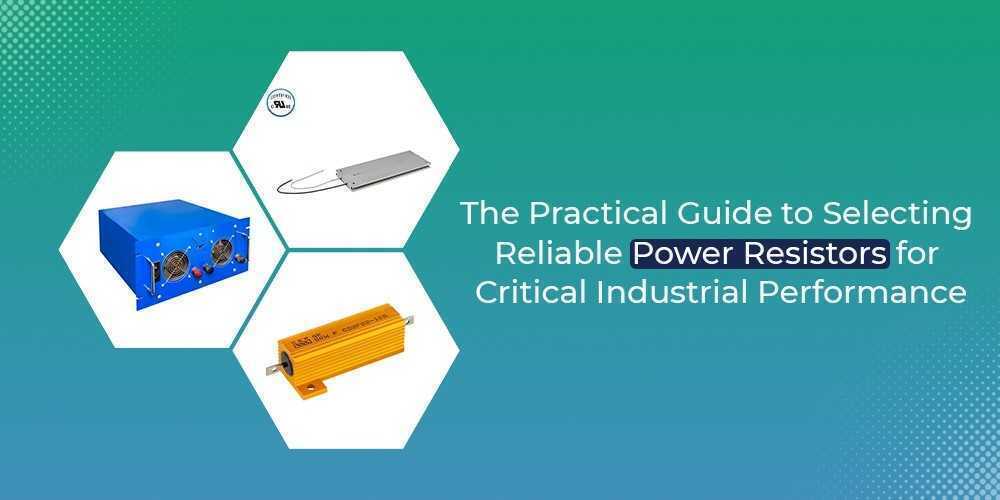
The Practical Guide to Selecting Reliable Power Resistors for Critical Industrial Performance
Summary
The effective selection of Power Resistors is a non-negotiable step for maintaining operational longevity and safety across high-demand electrical systems. This comprehensive guide provides the core, practical insights required to ensure you specify the correct resistance technology from basic wire-wound models to specialised options like Aluminium Housed Wire Wound Resistors to avoid thermal failures, manage transients, and solidify your system’s overall stability.
What is the single most important factor when choosing Power Resistors for any critical system?
The essential factor is the continuous power dissipation rating (wattage) matched directly to the anticipated maximum load, including a practical safety margin of at least 25% to account for environmental variables and intermittent surge conditions.
The Enduring Value of Robust Power Resistors in Industrial Circuitry
In the traditional landscape of electrical engineering, the Power Resistors family holds a pivotal and non-negotiable position. They are the essential components designed not merely to introduce opposition but, fundamentally, to dissipate significant amounts of electrical energy safely, often in the form of heat. Ignoring the proper specification of Power Resistors is a direct path to system failure, overheating, and costly downtime. We must maintain a traditional, disciplined outlook on component sourcing: quality and proven reliability always supersede short-term cost-cutting measures.
A forward-thinking view recognises that while technology evolves, the laws of physics do not. High-power circuits will always require dedicated components to manage current and voltage, and reliable Power Resistors are the original, tried-and-true solution.
Key Functions of Industrial Power Resistors
The necessity of Power Resistors spans multiple applications. Their primary role is often misunderstood as merely generating heat, yet their functional depth is far greater:
- Current Limiting: Protecting sensitive components by restricting current flow to a safe operating level.
- Voltage Division: Creating specific voltage levels within a circuit, essential for control systems.
- Damping Transients: Absorbing sudden energy spikes to protect system integrity.
- Load Simulation: Crucial for testing equipment, especially within dedicated Load Bank setups.
- Discharge Circuits: Safely draining residual energy from large capacitors after power removal.
The integrity of a system often hinges on its most stressed component, and in many applications, that is the Power Resistors unit.
Practical Considerations for Power Resistor Selection
To successfully navigate the selection process and ensure your project reaches its full operational potential, you must benchmark every potential Power Resistors against four critical specifications.
1. Power Rating and Safety Margin
While it may seem basic, the most frequent operational failure comes from under-specifying the continuous power rating.
- Always calculate the required power based on Ohm’s Law under maximum expected operating conditions.
- It is a sound engineering practice to select Power Resistors rated for 1.25 to 1.5 times the calculated maximum power. This safety margin mitigates temperature derating effects and accommodates unforeseen power fluctuations, significantly extending the life of the Power Resistors.
2. Resistance Tolerance and Stability
The application dictates how precise the resistance value must be. Precision-wound Power Resistors are required for measurement equipment and sensitive voltage dividers, whereas a 5% tolerance may be perfectly adequate for a simple Load Bank application or a motor discharge circuit.
- Temperature Coefficient of Resistance (TCR): This value is a critical metric for long-term stability. It describes how much the resistance value of the Power Resistors changes with every degree of temperature change. A lower TCR is preferable for high-precision, high-temperature operations.
3. Physical Construction and Thermal Management
The housing of a Power resistor determines its durability, environmental resistance, and, most importantly, how effectively it dissipates heat.
- Aluminium Housed Wire Wound Resistors: These are exemplary devices, offering excellent heat dissipation. Encased in an aluminium shell, they are often designed to be mounted directly to a chassis or heat sink, turning the entire assembly into a cooling system for the Power Resistors. This specific type of construction makes them ideal for inverters, braking systems, and robust Load Bank applications where environmental protection is also required.
- Cement and Ceramic: These offer good stability and fire resistance, traditionally used where space is less restricted.
4. Inductance and Frequency
In high-frequency applications, the inductive element created by the wire winding in certain Power Resistors can negatively impact circuit performance. For these specialised scenarios, non-inductive Power Resistors are the preferred pathway. Always be practical; choose the non-inductive type only when the operating frequency genuinely necessitates it.
Partnering for Longevity: The Cermet Resistronics Advantage
Finding the right Power Resistors is not just about consulting a datasheet; it requires partnership. As your service provider, Cermet Resistronics specialises in offering a spectrum of dependable, industrial-grade Power Resistors. By collaborating with a provider that values traditional quality and engineering rigour, you are ensuring your projects are built on a bedrock of reliable components. We encourage you to explore our full selection of Power Resistors, including high-durability Aluminium Housed wire-wound resistors, which are proven to maintain integrity under strenuous conditions. We stand ready to help you identify the precise Power Resistors solution needed to exceed your performance benchmarks.
The enduring success of any electrical system comes from having the right Power Resistors for the job. Do not compromise; choose proven quality for guaranteed longevity. The future of your operation depends on the components you select today.