

Our Blogs
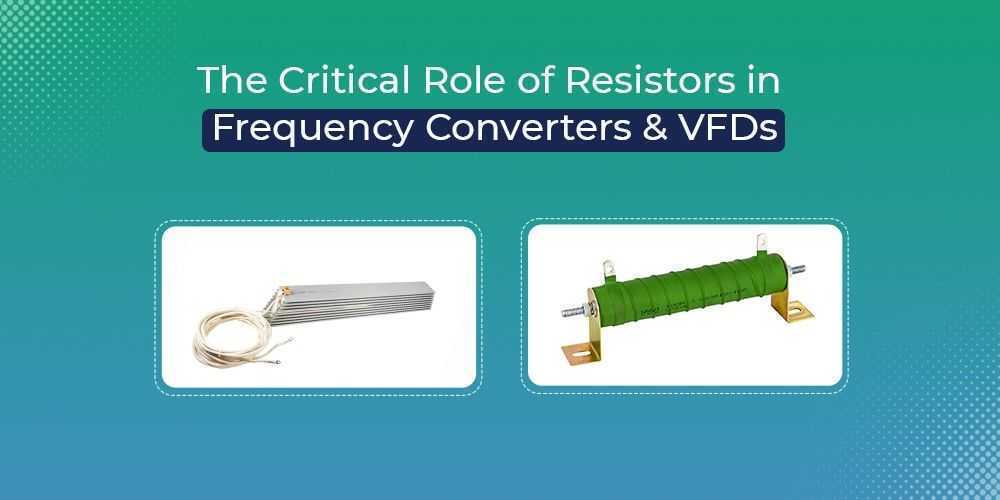
The Critical Role of Resistors in Frequency Converters & VFDs
This article explores the fundamental synergy between industrial motor control systems and high-quality resistive components. We examine how Frequency Converters & VFDs rely on robust braking solutions to manage regenerative energy, ensuring system stability and longevity. By understanding the technical requirements of dynamic braking, industries can improve performance and reduce downtime in complex automation environments.
To prevent overvoltage faults and ensure rapid deceleration in Frequency Converters & VFDs, you must integrate specialized braking resistors that safely dissipate excess kinetic energy as heat. This protects the drive’s internal components while allowing for precise control over high-inertia motor loads.
Understanding the Importance of Frequency Converters & VFDs
In the modern industrial landscape, the ability to control motor speed and torque is vital. Frequency Converters & VFDs (Variable Frequency Drives) serve as the primary tools for achieving this control. These devices operate by adjusting the frequency and voltage supplied to an electric motor, enabling significant energy savings and enhanced process accuracy. However, as these systems become more sophisticated, the need for reliable peripheral components increases.
When a VFD slows down a motor, or when a load tries to move faster than the motor’s synchronous speed, the motor begins to act as a generator. This creates regenerative energy that flows back into the drive. Without a way to manage this energy, the DC bus voltage within the Frequency Converters & VFDs will rise to dangerous levels, eventually causing the system to trip or sustaining hardware damage. This is where high-quality resistors become indispensable.
The Role of Dynamic Braking in Motor Control
Dynamic braking is the process of using a resistor to absorb the energy produced by a decelerating motor. For many applications, especially those involving heavy loads or rapid cycles, standard internal braking might not be sufficient. Cermet Resistronics provides specialized components that handle these demanding thermal loads effectively.
Integrating the right resistor ensures that your Frequency Converters & VFDs can operate at peak performance without interruption. Whether it is a conveyor system, a crane, or a centrifugal pump, managing the deceleration phase is just as important as managing the acceleration phase.
Aluminium Encased Dynamic Braking Resistors: Compact and Powerful
For many industrial setups, space is a luxury. This is why Aluminium Encased Dynamic Braking Resistors have become a preferred choice for engineers working with Frequency Converters & VFDs. These resistors are designed to provide high power dissipation within a relatively small footprint.
The aluminium housing acts as a natural heat sink, drawing warmth away from the resistive element and into the surrounding air or mounting surface. These resistors offer several advantages:
- High vibration resistance, making them ideal for heavy machinery.
- Excellent environmental protection against dust and moisture.
- High dielectric strength to ensure safety in high-voltage applications.
- Efficient thermal conductivity, which allows for higher power ratings in smaller sizes.
When configuring Frequency Converters & VFDs for tight control panels, these aluminium-clad units provide the reliability needed to maintain continuous operation without overheating.
Wire Wound Resistors (CSFR-Series): Durability for Heavy Loads
In scenarios where the energy levels are exceptionally high, or where the braking cycles are frequent and intense, Wire Wound Resistors (CSFR-Series) are the industry standard. These components are built to withstand significant thermal shock and provide a stable resistance value over a wide temperature range.
The CSFR-Series is specifically designed for high-power applications. These resistors use high-grade ceramic cores and specialized alloy wires to ensure that they can handle the heavy pulse loads often associated with large-scale Frequency Converters & VFDs.
Key features of the CSFR-Series include:
- Robust construction that survives harsh industrial environments.
- Superior pulse handling capabilities for repetitive braking cycles.
- Customizable mounting options to fit various cabinet configurations.
- Long-term stability that minimizes the need for frequent maintenance or replacement.
Using Wire Wound Resistors (CSFR-Series) in conjunction with your Frequency Converters & VFDs ensures that even the most demanding mechanical loads are brought to a halt safely and predictably.
Optimizing Performance for Industrial Automation
Selecting the right resistor for Frequency Converters & VFDs is not just about choosing a part; it is about system optimization. A poorly matched resistor can lead to overheating, shortened drive life, or inefficient braking. Engineers must consider the duty cycle, the peak power of the braking event, and the total energy to be dissipated.
By utilizing high-performance components from Cermet Resistronics, businesses can ensure their Frequency Converters & VFDs are equipped to handle the stresses of modern manufacturing. This leads to a more resilient infrastructure and a decrease in unexpected maintenance costs.
Why Choose Cermet Resistronics for Your VFD Needs?
Cermet Resistronics specializes in providing high-end resistive solutions that cater specifically to the needs of motor control and power electronics. Our expertise in manufacturing ensures that every unit, from Aluminium Encased Dynamic Braking Resistors to the specialized CSFR-Series, meets rigorous quality standards.
The integration of Frequency Converters & VFDs into your workflow is a significant investment. Protecting that investment requires the use of components that are built to last. Our resistors are tested to ensure they provide consistent performance, helping your systems stay online and productive.
Enhancing System Longevity
The heat generated during braking is the enemy of electronic longevity. By using efficient Aluminium Encased Dynamic Braking Resistors, you move that heat away from the sensitive electronics inside the Frequency Converters & VFDs. This thermal management is a key factor in extending the mean time between failures (MTBF) for industrial drives.
Furthermore, the stability provided by Wire Wound Resistors (CSFR-Series) ensures that the braking torque remains consistent. Inconsistent braking can lead to mechanical wear and tear on gears, belts, and couplings. Therefore, the right resistor protects both the electrical and mechanical aspects of your machinery.
Conclusion
Frequency Converters & VFDs are the backbone of modern industrial efficiency, but their success depends on the silent support of high-quality resistors. By incorporating Aluminium Encased Dynamic Braking Resistors and Wire Wound Resistors (CSFR-Series) into your system design, you ensure that your operations remain safe, efficient, and reliable.
As industrial requirements continue to evolve, the demand for precision in energy dissipation will only grow. Cermet Resistronics remains committed to providing the heavy-duty components necessary to keep your Frequency Converters & VFDs running at their best, regardless of the application or environmental challenges. Focusing on quality at the component level is the best way to achieve long-term success in industrial automation and motor control.