
Our Blogs
Evaluating the CSIA & CMSIA Series for Modern Auto Electronics Applications
Automotive electronic architecture demands robust components capable of handling high-voltage variations and sudden energy spikes. This technical blog explores the essential roles resistors perform within auto electronics and reviews the performance capabilities of specialized silicon-coated axial components.
Automotive circuitry achieves long-term durability and surge protection by utilizing high-grade wire-wound components that provide low temperature coefficients and low inductance.
The integration of advanced electronic systems in vehicles has altered modern automotive engineering. From critical power management to cabin comfort systems, electrical reliability is paramount. To maintain absolute stability, global auto electronics designs rely heavily on dependable hardware engineered by established wire-wound resistor manufacturers. These components ensure that volatile electrical environments do not compromise vehicle operation or user safety.
The Critical Role of Resistors in Auto Electronics
Auto electronics refers to the electronic systems and components used in automobiles to control various functions, enhance safety, improve comfort, and provide entertainment. Within these sophisticated networks, passive components act as the foundational structural guardrails for current flow.
Engineers implement high-reliability resistors to execute several distinct functions across vehicular circuitry:
- Voltage Division: Splitting voltage levels within multi-stage circuits to supply precise power to sensitive microcontrollers.
- Current Limiting: Protecting delicate semi-conductors and LED systems from over-current conditions.
- Signal Conditioning: Filtering electrical noise out of sensor paths to ensure clean data transmission to the central engine control unit.
- Temperature and Current Sensing: Monitoring real-time thermal and energy fluctuations to trigger onboard safety protocols.
- Lighting Systems: Balancing power distributions across high-intensity exterior and internal passenger cabin lighting arrays.
Because automotive systems face intense vibrations, thermal cycling, and sudden power fluctuations, standard commercial-grade components are insufficient. Partnering with dedicated wire-wound resistor suppliers guarantees that the materials used can withstand these severe operational pressures over a long lifespan.
Spotlighting the CSIA & CMSIA Series
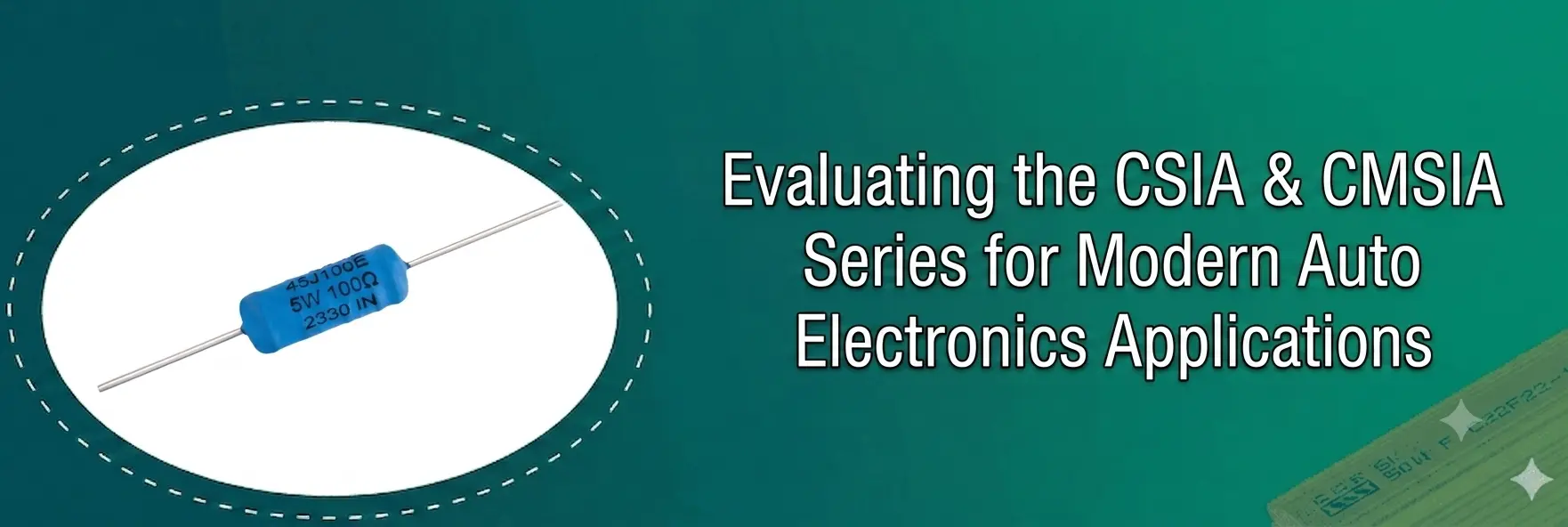
When selecting hardware for demanding automotive applications, the CSIA & CMSIA Series of silicon-coated axial wire-wound resistors stands out as an industry benchmark. Developed by specialized wire-wound resistor manufacturers, these components are optimized to manage high-energy loads while maintaining physical footprint efficiency.
The CSIA & CMSIA Series features a high-grade Ni-Cr wire-wound element wound carefully over a robust ceramic core. To ensure total isolation and environmental protection, the assembly is encased within a heat-insulating, flame-proof coating. This specific layout makes them exceptionally suitable for high-surge environments such as automotive instrumentation, electronic braking frameworks, and utility energy meters. By utilizing advanced design methodologies like Aryton-Perry winding, these components effectively reduce residual inductance, providing clean, predictable performance during high-frequency operations.
Key Specifications and Technical Compliance
To meet the stringent design benchmarks of modern hardware layout engineers, components must conform to exact structural guidelines. The following specifications highlight the build quality provided by leading wire-wound resistor suppliers:
- Core Element Construction: High-grade Nickel-Chromium (Ni-Cr) alloy wound on a pure ceramic substrate.
- Protective Encasement: Silicon-based, heat-insulating, and flame-proof outer coating.
- Inductance Minimization: Available with Aryton-Perry winding options to ensure low inductance.
- Standard Manufacturing Tolerances: Produced in precise 1%, 2%, and 5% tolerance options to match diverse circuit complexities.
- Regulatory Standardization: Fully conforming to JSS 50402 quality standards for verified performance metrics.
- Thermal Performance: Features a low temperature coefficient of resistance (TCR), preventing value drift during massive operational temperature swings.
- Visual Identification: Finished with standard color-coded or printed markings for rapid line assembly and troubleshooting identification.
Why Sourcing from Verified Manufacturers Matters
Choosing the right production partner directly influences the field performance of vehicular sub-assemblies. Experienced wire-wound resistor manufacturers implement comprehensive material testing to verify that wire tension, core integrity, and coating thickness remain uniform across high-volume production batches.
When global sourcing teams collaborate with reputable wire-wound resistor suppliers, they gain access to specialized components that prevent system failures caused by thermal shock or sudden electrical overloads. Choosing verified components ensures that vital automotive functions ranging from powertrain sensing to driver assistance mechanisms remain operational under all driving conditions.
Secure Your Automotive Supply Chain Today
Don’t let electrical surges compromise your automotive system reliability. Contact Cermet Resistronics, one of the trusted wire-wound resistor manufacturers, to request a quote or source high-performance CSIA & CMSIA Series samples for your next production run.
Frequently Asked Questions (FAQs)
1. What makes wire-wound resistors suitable for auto electronics compared to film resistors?
Wire-wound resistors offer much higher surge-withstanding capabilities and superior thermal dissipation because of their physical construction. The use of a metallic alloy wire wound around a solid ceramic core allows them to absorb brief, intense energy spikes without sustaining structural damage, unlike thin film alternatives.
2. How does the Aryton-Perry winding benefit automotive electronic circuits?
Standard wire winding inherently creates a magnetic coil effect, which increases parasitic inductance and distorts high-frequency signals. Aryton-Perry winding utilizes two opposing wire paths to cancel out this magnetic field, resulting in a low-inductance component that preserves signal clarity in sensitive auto electronics.
3. What does compliance with the JSS 50402 standard signify?
Compliance with JSS 50402 indicates that the component has passed rigorous qualification benchmarks regarding environmental endurance, thermal stability, and mechanical strength. This compliance guarantees to engineers that the components will perform reliably under demanding industrial and automotive deployment conditions.