

Our Blogs
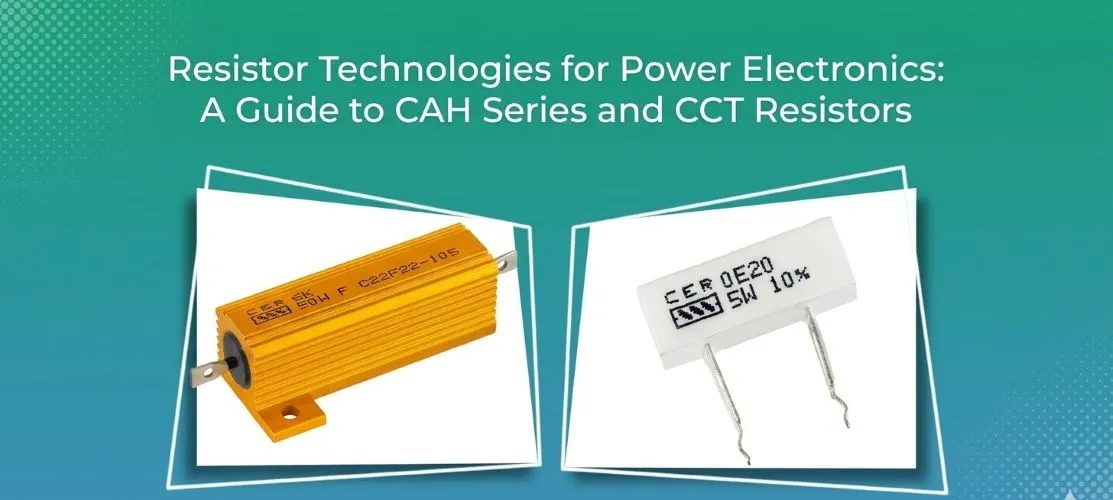
Resistor Technologies for Power Electronics: A Guide to CAH Series and CCT Resistors
High-performance electrical systems require robust components to manage heat and maintain stability. This blog explores the technical advantages of Aluminium Housed Wire Wound Resistors (CAH Series) and CCT resistors, highlighting how these solutions from Cermet Resistronics ensure long-term reliability in demanding power electronics and automotive applications.
To ensure optimal heat dissipation and circuit protection in high-power environments, engineers should use chassis-mounted aluminium-housed wire-wound resistors (CAH Series) for heavy loads, or the compact, flame-proof CCT series for PCB-level stability.
Optimizing Power Electronics with High-Performance Resistors
In the world of industrial design and power electronics, the ability to manage electrical loads while maintaining a compact footprint is a constant challenge. Standard film resistors often fall short when faced with high-voltage surges or extreme thermal stress. This is where specialized components like Aluminium Housed Wire Wound Resistors (CAH Series) and CCT resistors become indispensable. As a leading service provider, Cermet Resistronics focuses on delivering high-stability solutions that keep critical systems running without interruption.
Aluminium Housed Wire Wound Resistors (CAH Series):
When your application demands maximum heat dissipation, the Aluminium Housed Wire Wound Resistors (CAH Series) are the preferred choice. These professional-grade components feature a high-grade Ni-Cr wire-wound element on a ceramic core, encased in a robust aluminium housing.
The primary advantage of the Aluminium Housed Wire Wound Resistors (CAH Series) lies in their mechanical design. The aluminium casing acts as a built-in heat sink. When these resistors are screw-mounted to a metal chassis, the heat-sink effect is significantly enhanced, allowing the component to handle power ratings from 5W up to 500W.
Key Features of the CAH Series:
- Excellent heat dissipation through chassis mounting.
- Complete environmental protection for harsh industrial settings.
- High stability with low temperature coefficients.
- Standard tolerances are available in 1%, 2%, and 5%.
- Non-inductive versions available for specific high-frequency needs.
These resistors are frequently found in EV pre-charge circuits, dynamic braking systems, and motor drives where managing sudden energy bursts is vital for safety.
CCT Series: Compact and Flame-Proof Protection
While the CAH series excels in chassis-mounted applications, many modern designs require protection directly on the PCB. The CCT (Ceramic Case Technology) series is designed to fill this gap. These small-sized resistors are often the unsung heroes in electrical appliances and power distribution units.
The CCT series features a high-grade Ni-Cr wire wound element on a ceramic core, much like its aluminium-housed counterpart. However, it is encased in a ceramic body and sealed with flame-proof silicon cement. This construction ensures that even under extreme overload conditions, the resistor remains safe and does not become a fire hazard.
Advantages of CCT Resistors:
- Small footprint ideal for space-constrained PCB layouts.
- Flame-proof design ensures high safety standards.
- Adaptable to wave soldering processes with various PCB terminal stand-off heights.
- High ohmic values available with MOR (Metal Oxide Resistor) elements.
- Reliable performance in automotive battery management systems (BMS).
Applications in Modern Power Electronics
Both the Aluminium Housed Wire Wound Resistors (CAH Series) and the CCT series play critical roles in the evolution of green technology and industrial automation. For instance, in solar inverters and wind turbine converters, these resistors manage the inflow of energy during startup, preventing damage to sensitive capacitors.
In the automotive sector, especially with the shift toward electric vehicles (EVs), the Aluminium Housed Wire Wound Resistors (CAH Series) are used for pre-charging the high-voltage DC bus. This prevents a massive current inrush that could weld contactors or damage the battery. Meanwhile, CCT resistors provide localized current sensing and voltage regulation within the vehicle’s control units.
Why Choose Cermet Resistronics?
With decades of expertise in resistor technology, Cermet Resistronics provides more than just components; we provide reliability. Our manufacturing processes prioritize data-driven quality, ensuring that every Aluminium Housed Wire Wound Resistors (CAH Series) and CCT unit meets strict industrial standards.
Whether you are designing a high-speed elevator system, a medical diagnostic machine, or a heavy-duty industrial motor controller, selecting the right resistor technology is a fundamental step toward system longevity. By integrating Aluminium Housed Wire Wound Resistors (CAH Series) for chassis-level power handling and CCT resistors for PCB-level protection, you create a robust electrical architecture capable of withstanding the most demanding conditions.
Contact our experts today to discuss specialized ohmic values or custom mounting options for the Aluminium Housed Wire Wound Resistors (CAH Series).
Frequently Asked Questions (FAQs)
- What makes the CAH series better for heat management than standard resistors?
The Aluminium Housed Wire Wound Resistors (CAH Series) use a metal casing that functions as a heat sink. When mounted to a chassis, the heat is transferred away from the internal wire-wound element much faster than a standard resistor could manage on its own.
- Can the CCT series be used in high-temperature environments?
Yes, the CCT series is specifically encased in ceramic and sealed with flame-proof silicon cement. This construction is designed to withstand high temperatures and prevent combustion, making it a safe choice for power electronics.
- Are there custom versions of these resistors available?
Cermet Resistronics offers customized variations for both the Aluminium Housed Wire Wound Resistors (CAH Series) and CCT series. This includes special ohmic values, tighter tolerances, and different terminal configurations to fit specific project requirements.