
Our Blogs
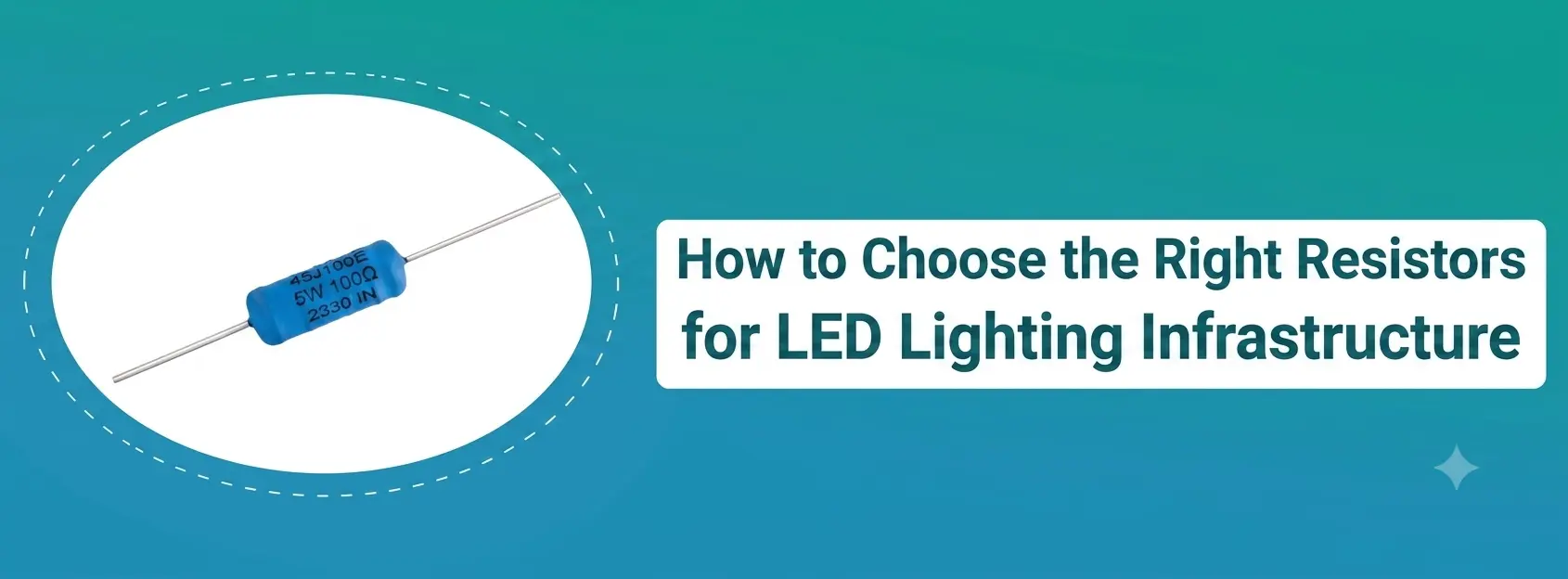
How to Choose the Right Resistors for LED Lighting Infrastructure
Modern LED lighting systems rely on precise thermal and electrical management to ensure long-term operational stability. This article highlights the technical role of specialized components like the CSIA & CMSIA Series resistors in balancing voltage drops, regulating driver circuits, and protecting commercial light infrastructure against sudden electrical surges.
LED lighting systems require dedicated resistors to effectively limit forward current and manage voltage fluctuations, preventing premature thermal failure and ensuring consistent brightness across parallel or series configurations.
The global transition to LED technology is driven by energy efficiency and prolonged operational life. However, maintaining these systems requires robust electrical stability. Industrial and commercial LED setups run on sophisticated driver circuits that are highly sensitive to thermal overloads and electrical fluctuations. To protect these setups, global engineering teams work closely with high-power wire-wound resistor manufacturers to source specialized components capable of handling heavy electrical loads. Without appropriate current management, LEDs face thermal runaway, which reduces brightness and drastically cuts down the overall lifespan of the commercial lighting fixture.
The Role of Components in LED Driver Circuitry
Within an LED lighting system, individual light-emitting diodes operate on low direct current voltage. Because main power sources supply much higher voltage levels, driver circuits must safely adapt the energy flow. Passive components are integrated into these configurations to execute several vital electronic functions. Experienced high-power wire-wound resistor suppliers emphasize that managing energy distribution within the driver circuit prevents sudden component failure.
In a typical commercial setup, these specialized components perform the following foundational tasks:
- Limiting the overall forward current passing through the semiconductor material to prevent overheating.
- Dropping excessive supply voltage safely across the circuit before it interacts with sensitive LED elements.
- Balancing currents perfectly when handling large, multi-diode series or parallel circuit arrangements.
- Regulating the active current loops inside modern dimming and control systems to ensure flicker-free operation.
Integrating the CSIA & CMSIA Series Resistors
When selecting components for demanding environments, the CSIA & CMSIA Series resistors provide high stability and durability. These silicon-coated axial components are designed explicitly for power applications that demand exceptional surge-withstanding capability. Manufactured with a high-grade Ni-Cr wire-wound element wrapped securely on a robust ceramic core, these units offer reliable insulation and are protected with an advanced flame-proof coating. This makes them highly practical for the heavy inrush currents frequently encountered during the startup phase of high-wattage LED drivers and electronic energy meters.
Engineering teams prefer the CSIA & CMSIA Series resistors because they incorporate an Aryton-Perry winding structure. This specific design ensures very low inductance, which is a vital requirement for high-frequency switching power supplies used in smart lighting. Additionally, these components feature a low temperature coefficient, which means their resistance values remain steady even as the ambient operating temperature of the lighting system rises during extended usage.
Technical Specifications and Material Design
Sourcing from verified high-power wire-wound resistor manufacturers allows engineers to match exact system needs with certified components. High-quality production methods ensure that components maintain electrical tolerance values over thousands of operational hours. For complex driver circuits, these specifications guarantee that power drops remain fully predictable.
The primary design features and performance specifications of these industrial-grade wire-wound components include:
- Core Construction: High-grade Nickel-Chromium (Ni-Cr) resistance wire wound carefully on a solid ceramic core for maximum thermal dissipation.
- External Protection: Multi-layer heat-insulating and flame-proof coating to withstand severe thermal stress.
- Inductance Control: Specialized Aryton-Perry winding method utilized to minimize inductive reactance in switching circuits.
- Electrical Tolerances: Standard tolerances available at 1%, 2%, and 5% configurations to allow precise circuit design.
- Regulatory Compliance: Manufactured conforming to JSS 50402 standards, ensuring industrial and defense-grade reliability.
- Identification Systems: Standardized color-coded or printed bodies for straightforward part identification during assembly and maintenance.
Sustaining Efficiency in Commercial Environments
Selecting low-grade passive components frequently results in system downtime. When a resistor fails under thermal stress, it can create an open circuit that shuts down entire sections of a lighting grid, or a short circuit that exposes expensive LEDs to destructive overcurrents. Working with reliable high-power wire-wound resistor suppliers allows procurement teams to secure components that offer excellent long-term environmental stability. By prioritizing low temperature coefficients and high surge capacities, engineering firms can design commercial lighting systems that consistently meet industrial efficiency targets.
Secure Industrial Components for Your Next Project
Optimize the durability of your commercial lighting infrastructure with field-proven component engineering. Contact Cermet Resistronics today to discuss your technical specifications, request detailed product documentation, or receive a customized quote for our high-precision resistor series.
Frequently Asked Questions
- Why do LED lighting circuits require wire-wound resistors instead of standard carbon film options?
LED driver circuits often encounter substantial inrush currents during startup. Wire-wound options utilize a solid ceramic core and high-grade Ni-Cr wire, enabling them to absorb and dissipate high-energy surges without structural degradation, whereas standard film components might fail instantaneously under identical surge conditions.
- What is the significance of the Aryton-Perry winding in lighting applications?
Aryton-Perry winding uses two parallel wires wound in opposite directions around the core. This effectively cancels out internal inductive properties, creating a low-inductance component that works smoothly within fast-switching LED driver circuits without causing unwanted signal noise or circuit instability.
- How does a low temperature coefficient benefit commercial lighting systems?
As lighting enclosures run continuously, internal temperatures increase. A component with a low temperature coefficient maintains its specified resistance value despite temperature shifts, ensuring the current supplied to the LEDs stays uniform, preventing flickering and safeguarding system stability.