

Our Blogs
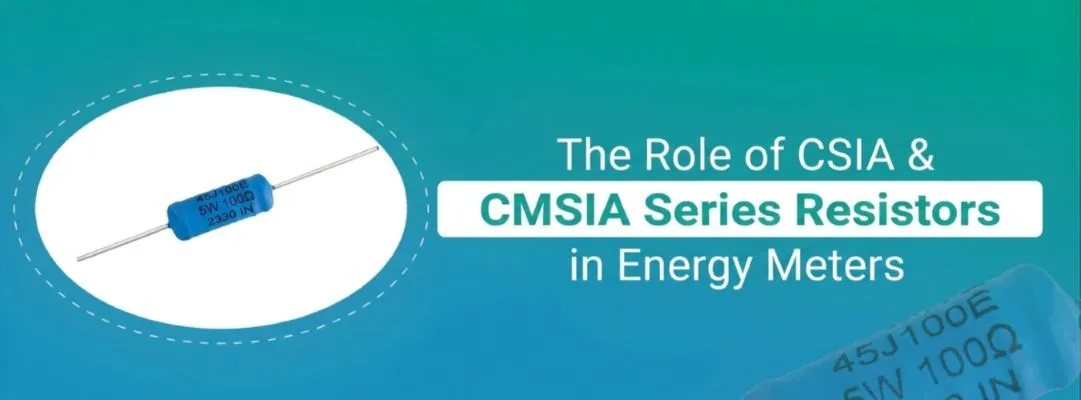
The Role of CSIA & CMSIA Series Resistors in Energy Meters
Precision in energy measurement is the foundation of modern billing and grid management. This blog examines how the CSIA & CMSIA Series provides the necessary thermal stability and low resistance values required for high-accuracy energy meters. By focusing on the technical advantages of thick film technology and the manufacturing standards at Cermet Resistronics, we highlight how these components solve common issues related to measurement drift and heat dissipation in industrial environments.
These components use advanced thick-film materials to maintain a low temperature coefficient and high power rating, ensuring current sensing remains accurate even under fluctuating thermal loads.
The Evolution of Precision in Energy Metering
Modern energy infrastructure requires a level of accuracy that was previously difficult to achieve with standard components. As smart meters become the global standard for residential and industrial monitoring, the focus has shifted toward the internal components that handle current sensing. The CSIA & CMSIA Series resistors have emerged as a critical solution for engineers who need to balance cost-effectiveness with extreme reliability. When measuring electricity consumption, even a minor deviation in resistance can lead to significant billing errors or system imbalances over time.
Energy meters function by monitoring the voltage drop across a known resistance value. If that resistor changes its properties due to heat or environmental stress, the readings become unreliable. This is where the CSIA & CMSIA Series becomes indispensable. By using materials designed to resist thermal expansion and contraction, these resistors provide a stable platform for long-term data collection.
Understanding the Technical Strength of the CSIA & CMSIA Series
The CSIA & CMSIA Series is specifically engineered for current sensing applications where high wattage and low ohmic values are mandatory. Unlike standard resistors that might fail under the continuous load of a primary power line, the CSIA & CMSIA Series is built to withstand high-current environments without compromising its structural integrity.
One of the primary benefits of the CSIA & CMSIA Series is its low Temperature Coefficient of Resistance (TCR). In practical terms, this means as the energy meter operates and generates internal heat, the resistance value of the CSIA & CMSIA Series remains nearly constant. This stability is vital for utility providers who must guarantee a specific class of accuracy for their metering hardware.
Furthermore, the CSIA & CMSIA Series incorporates thick film technology, which offers a rugged construction capable of handling pulses and surges. In industrial settings where heavy machinery might cause sudden spikes in the electrical load, the CSIA & CMSIA Series acts as a robust sensing element that protects the sensitivity of the internal microcontroller by providing predictable voltage outputs.
Why Cermet Resistronics Focuses on the CSIA & CMSIA Series
As a dedicated service provider, Cermet Resistronics understands that the energy sector cannot afford downtime or inaccurate reporting. The production of the CSIA & CMSIA Series involves rigorous testing protocols to ensure every unit meets the stringent requirements of international energy standards. By integrating the CSIA & CMSIA Series into their product roadmap, manufacturers can ensure their meters are ready for the demands of 24/7 grid monitoring.
The CSIA & CMSIA Series is also designed with a footprint that supports modern automated assembly. As the industry moves toward smaller, more efficient meter designs, the compact nature of the CSIA & CMSIA Series allows for more flexible PCB layouts. This flexibility does not come at the expense of performance, as the CSIA & CMSIA Series maintains its power rating despite its streamlined dimensions.
Comparing CSIA & CMSIA Series with Traditional Components
In the past, many energy meters relied on bulky wirewound resistors or simple metal strips for current sensing. However, these older methods often struggled with parasitic inductance and physical size constraints. The CSIA & CMSIA Series solves these issues by offering a non-inductive design that is perfect for high-frequency measurement environments.
When engineers select the CSIA & CMSIA Series, they are choosing a component that has been optimized for the specific challenges of the energy sector. The CSIA & CMSIA Series offers superior moisture resistance and anti-sulfuration properties, which are essential for meters installed in outdoor or harsh industrial locations. Without the protection provided by the CSIA & CMSIA Series, resistors can degrade over time, leading to a loss of calibration that is expensive to fix.
Cermet Resistronics has seen a growing demand for the CSIA & CMSIA Series because it bridges the gap between high-end laboratory precision and everyday industrial durability. The CSIA & CMSIA Series is not just a component; it is a guarantee of measurement integrity.
Integration with High Voltage Systems
For applications involving high voltage monitoring, similar to the standards found in the CFHVR Series, the CSIA & CMSIA Series provides a complementary role. While high voltage resistors manage the potential, the CSIA & CMSIA Series handles the current monitoring aspect with equal precision. The synergy between these types of components allows for the creation of comprehensive power analysis tools.
By implementing the CSIA & CMSIA Series, designers can reduce the need for complex software compensation. Since the CSIA & CMSIA Series is inherently stable, the system requires fewer digital corrections to account for temperature changes. This simplifies the overall design of the energy meter and reduces the processing load on the system’s CPU.
As we look toward a future dominated by renewable energy and smart grids, the CSIA & CMSIA Series will continue to play a pivotal role. The ability to monitor bi-directional power flow in solar-equipped homes requires the precision that the CSIA & CMSIA Series provides. Cermet Resistronics remains committed to refining the CSIA & CMSIA Series to meet even tighter tolerances as metering technology advances.
In conclusion, the CSIA & CMSIA Series represents the peak of current sensing technology for the modern era. By choosing the CSIA & CMSIA Series for your next project, you ensure that your energy meters remain accurate, reliable, and durable for years to come. Cermet Resistronics continues to lead the way in providing the CSIA & CMSIA Series to global manufacturers who demand nothing but the best for their electrical measurement needs.
Frequently Asked Questions
1. What makes the CSIA & CMSIA Series suitable for smart meters?
The CSIA & CMSIA Series offers low resistance values and high thermal stability, which are essential for the digital accuracy required by smart metering systems to track real-time energy usage.
2. Can the CSIA & CMSIA Series handle industrial power surges?
Yes, the thick film construction of the CSIA & CMSIA Series is designed to withstand pulse loads and sudden current increases, making it highly reliable for industrial environments.
3. How does the TCR of the CSIA & CMSIA Series affect billing accuracy?
A low TCR ensures that the resistance of the CSIA & CMSIA Series does not change as the meter heats up. This prevents measurement drift, ensuring that the consumer is billed accurately regardless of the operating temperature.