

Our Blogs
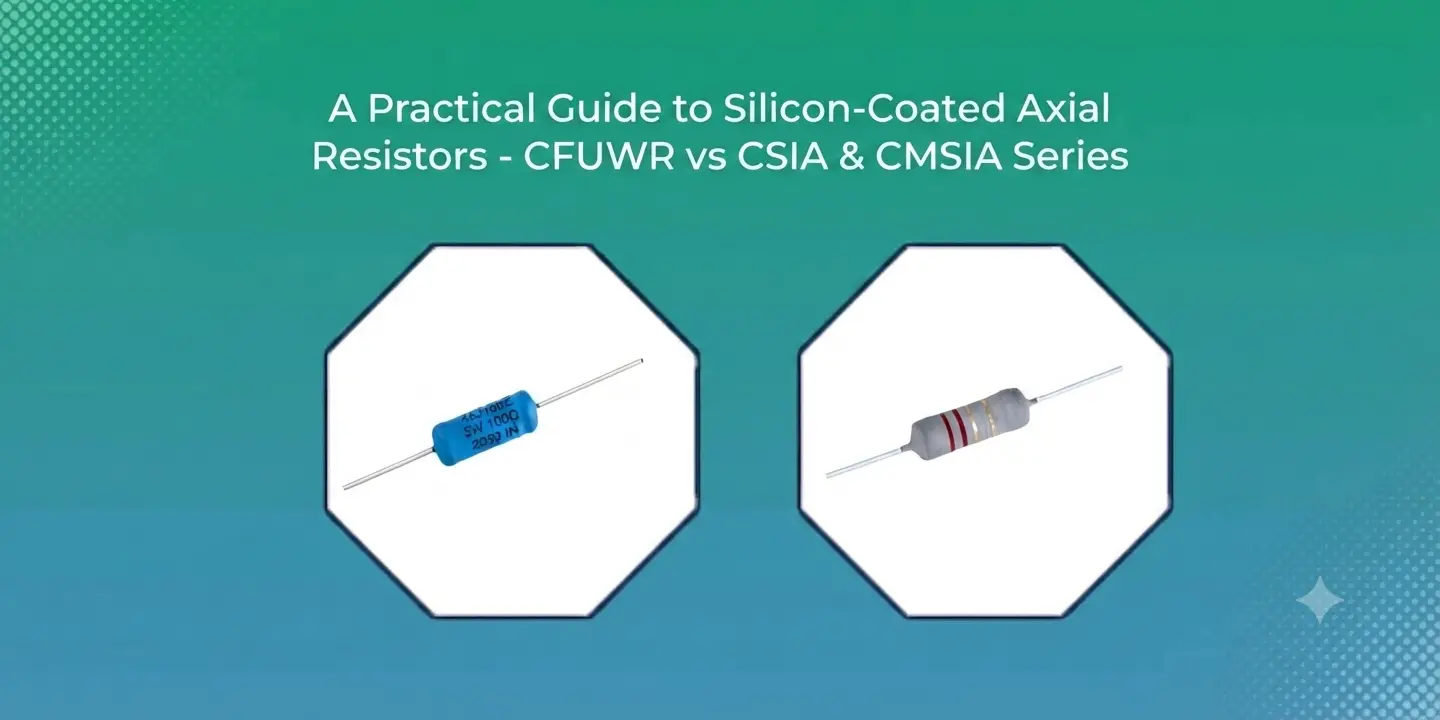
A Practical Guide to Silicon-Coated Axial Resistors- CFUWR vs CSIA & CMSIA Series:
Silicon-coated axial resistors are wire-wound components built around a Ni-Cr element on a ceramic core, finished with a non-flammable coating that withstands heat and current surges. Cermet Resistronics offers two versions worth knowing apart: the CFUWR Series, which doubles as a fuse when current overflows, and the CSIA & CMSIA Series, designed for energy meters and circuits that need low inductance and high surge tolerance. Picking the right one comes down to one question: does your circuit need overload protection, or does it need measurement-grade stability?
What Makes a Silicon-Coated Axial Resistor Different
A regular wire-wound resistor is just wire on a core. A silicon-coated axial resistor adds a heat-insulating, flame-proof outer layer over that wire element, which changes how the part behaves once things get hot or overloaded. The coating stops the winding from catching fire, keeps the temperature coefficient low, and makes the part stable enough for long-term use in industrial panels, auto electronics, energy meters, and lighting circuits.
Both the CFUWR Series and the CSIA & CMSIA Series from Cermet Resistronics share this base construction, but they’re built for different jobs on the circuit board. Here’s a quick side-by-side look.
CFUWR Series vs CSIA & CMSIA Series Comparison
| Feature | CFUWR Series | CSIA & CMSIA Series |
| Core function | Resistor + fuse (opens circuit on overload) | Precision resistor for measurement circuits |
| Winding element | High-grade Ni-Cr wire on ceramic core | High-grade Ni-Cr wire on ceramic core |
| Coating | Non-flammable silicon coating | Heat-insulating, flame-proof coating |
| Special design | Fully automated safety-grade build | Aryton-Perry winding for low inductance |
| Surge handling | Interrupts circuit on current overflow | High surge withstanding capability |
| Tolerance | Standard 5% | 1%, 2%, and 5% |
| Standard compliance | Not specified | Conforms to JSS 50402 |
| Typical use case | Equipment protection, safety circuits | Energy meters, power electronics, auto electronics |
| Identification | Colour coded or printed | Colour coded or printed |
CFUWR Series: The Resistor That Also Protects Your Circuit
The CFUWR Series is built with equipment safety as the priority. It works exactly like a standard resistor under normal load, but the moment current overflows past what the circuit is rated for, it acts as a fuse and breaks the connection. That single behavior removes the need for a separate fuse component in many designs.
Key points on this series:
- Manufactured through a fully automated process for consistent quality
- Uses a high-grade Ni-Cr wire-wound element on a ceramic core
- Functions as a resistor under normal operating conditions
- Switches to fuse behavior when current overflows, protecting downstream components
- Non-flammable silicon coating adds a layer of thermal safety
- Low temperature coefficient keeps resistance stable across operating ranges
- Comes color coded or printed for quick identification on the line
- Available across a wide resistance range with a standard 5% tolerance
This makes the CFUWR Series a good fit anywhere overcurrent is a real risk: control panels, power supply boards, and any application where a burnt-out resistor could otherwise take other parts down with it.
CSIA & CMSIA Series: Built for Energy Meters and Precision Loads
The CSIA & CMSIA Series takes a different approach. Instead of doubling as a fuse, it focuses on accuracy and surge tolerance, which is why it shows up so often in energy meters, power electronics, and auto electronics.
What stands out in this series:
- High-grade Ni-Cr wire-wound element on a ceramic core
- Coated with a heat-insulating, flame-proof layer for durability
- High surge-withstanding capability, well suited to energy meter circuits
- Low temperature coefficient combined with high stability over time
- Aryton-Perry winding, which keeps inductance low, is important in metering accuracy
- Available in 1%, 2%, and 5% tolerance options depending on precision needs
- Conforms to JSS 50402, a recognized specification for this resistor category
- Color coded or printed for easy identification during assembly
Because the winding method limits inductance, this series holds its rated value more consistently under AC conditions, which matters a great deal in metering and measurement applications where even small drift affects readings.
Which One Should You Choose?
If your circuit needs built-in overload protection alongside normal resistance, the CFUWR Series does both jobs in one part. If your application is an energy meter, power electronics board, or any circuit where measurement accuracy and low inductance matter more than fuse behavior, the CSIA & CMSIA resistor series is the better match.
Both series are available from Cermet Resistronics, a manufacturer with over 34 years of experience producing high-precision resistors for industrial and electronic applications, along with full datasheets for engineers who need exact dimensional and electrical data before finalizing a design.
Frequently Asked Questions
- What is the main difference between the CFUWR Series and the CSIA & CMSIA Series? The CFUWR Series acts as both a resistor and a fuse, opening the circuit during current overflow. At the same time, the CSIA & CMSIA Series is built for precision and surge tolerance in measurement circuits like energy meters.
- Why are silicon-coated axial resistors used instead of standard wire-wound resistors? The silicon coating makes the winding non-flammable and heat-insulating, which improves safety and stability in circuits that see heat buildup or current surges.
- What tolerance options are available in the CSIA & CMSIA Series? The CSIA & CMSIA Series is available in 1%, 2%, and 5% standard tolerances, giving designers flexibility based on how precise the application needs to be.