


Our Blogs
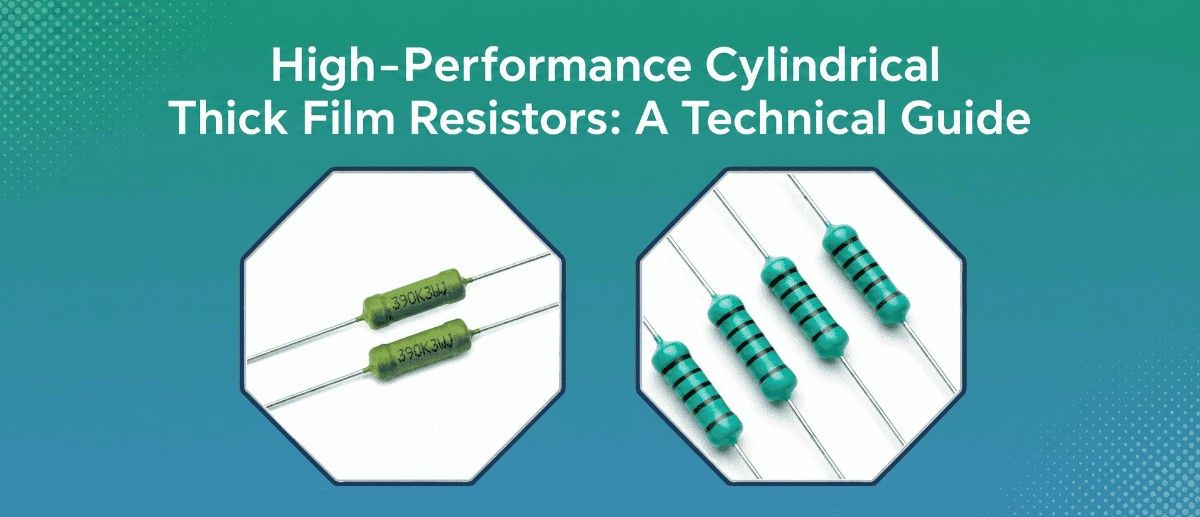
High-Performance Cylindrical Thick Film Resistors: A Technical Guide
This guide explores the technical capabilities of high-performance cylindrical thick film resistors, focusing on the CSK series for general high-performance needs and the CMGR series for extreme high-voltage and high-ohmic applications. Understanding these components is essential for engineers working with power electronics, VFDs, and industrial systems.
The Role of Cylindrical Thick Film Resistors in Modern Electronics
In the field of power electronics, the ability to maintain stability under harsh conditions is paramount. Cylindrical thick film resistors are engineered to provide this reliability. Whether you are managing VFDs, energy meters, or EV pre-charge circuits, selecting the right resistive component determines the longevity and precision of the entire system. These resistors are built to handle specific thermal and electrical stresses that standard surface-mount or carbon-film components often cannot withstand.
Thick Film Metal Oxide Resistors (CSK Series)
The CSK series of thick film metal oxide resistors provides a compact, high-performance solution for circuits where space is limited but electrical demands are significant. These resistors are specifically designed to offer low noise operation combined with very high resistance values. A key advantage of the CSK series is its ability to handle high heat dissipation while maintaining humidity resistance, which is critical for industrial environments. Engineers can choose between inductive or non-inductive types depending on the specific frequency requirements of the application. With standard tolerances of 1%, 2%, and 5%, these components are reliable for everyday electronic functions.
Key Specifications of the CSK Series:
- Performance: High electrical and mechanical durability.
- Design: Compact size for space-constrained applications.
- Heat & Humidity: Engineered for high heat dissipation and moisture resistance.
- Options: Available in color-coded or printed versions; inductive and non-inductive types.
- Tolerance: Standard 1%, 2%, and 5%.
Metal Glaze Resistors (CMGR Series)
When an application requires handling extreme voltages or massive resistance values, the CMGR series stands out as the industry standard. These metal glaze resistors are constructed to manage up to 200 Giga Ohms of resistance and can withstand voltages as high as 25kV. Beyond their voltage capabilities, they are highly effective in surge-prone environments, offering surge withstand capabilities up to 50kV. These components are coated with high-insulating epoxy paints to ensure safety and performance, maintaining an excellent stability factor of 2% in demanding conditions.
Key Specifications of the CMGR Series:
- Resistance Range: Up to 200 Giga Ohms.
- Voltage Withstanding: Up to 25KV.
- Surge Capability: Up to 50KV.
- Stability: 2% excellent stability.
- Protection: Coated with high-insulating epoxy paints for environmental durability.
- Standard Tolerance: 1%, 2%, and 5%.
Contact Our Engineering Team Today
Need help finding the exact resistive component for your industrial application? Contact Cermet Resistronics to request technical datasheets or get expert assistance for your specific project requirements.
Frequently Asked Questions
- What is the main difference between CSK and CMGR resistors?
The CSK series is designed for general high-performance and high-heat applications, whereas the CMGR series is specifically engineered for extreme high-voltage and very high ohmic requirements.
- Can these resistors be used in EV pre-charge circuits?
Yes, both cylindrical thick film resistor types are commonly used in power electronics applications, including EV pre-charge systems, due to their robust construction and ability to handle transient loads.
- What tolerance levels are available for these series?
Both the CSK and CMGR series typically offer standard tolerances of 1%, 2%, and 5%, allowing for flexibility in circuit design.