


Our Blogs
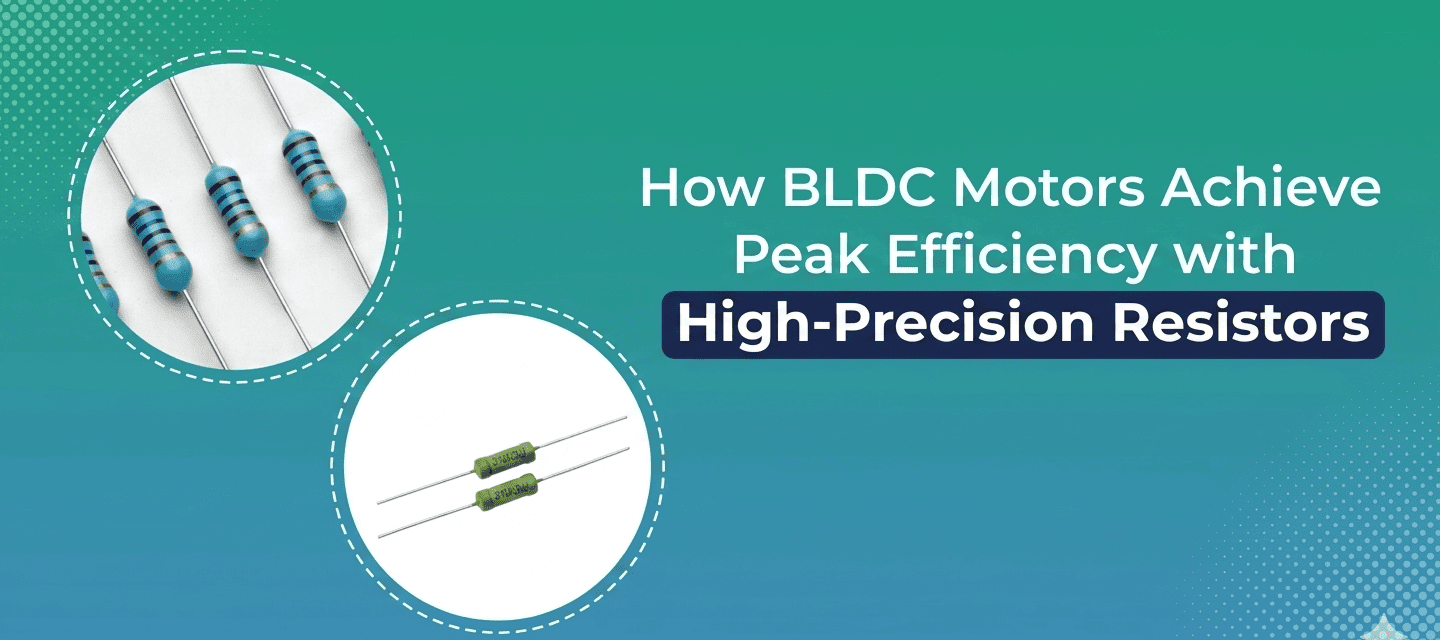
How BLDC Motors Achieve Peak Efficiency with High-Precision Resistors
This technical guide explores the essential relationship between Brushless DC (BLDC) motor performance and the passive components that drive their control systems. By examining the specific functions of Metal Film Resistors and Thick Film Metal Oxide Resistors, we analyze how component selection impacts efficiency, heat dissipation, and overall system reliability in industrial and automotive environments.
High-performance BLDC motors require precise current sensing and robust surge protection, which are best achieved by integrating low-noise Metal Film Resistors for feedback loops and high-stability Thick Film Metal Oxide Resistors for handling voltage fluctuations.
Understanding the Architecture of BLDC Motors
Brushless DC (BLDC) motors have become the standard for applications requiring high torque-to-weight ratios and high-speed operation. Unlike traditional brushed motors, these systems rely on electronic commutation, which necessitates a sophisticated controller to manage power delivery to the motor windings. This transition to electronic control places a higher demand on the passive components within the circuit.
The efficiency of a BLDC motor is not just a result of its mechanical design but also the accuracy of its sensing circuits. To maintain smooth rotation and prevent energy loss, the controller must receive accurate feedback regarding the position and speed of the rotor. This is where the choice of resistors becomes a defining factor in the performance of the hardware.
Precision Feedback with Metal Film Resistors
In the feedback and control stages of a BLDC motor driver, accuracy is non-negotiable. Metal Film Resistors are frequently selected for these circuits because of their superior stability and low noise characteristics. These resistors are manufactured by depositing a thin layer of metal onto a high-grade ceramic core, resulting in a component that maintains its resistance value even under varying temperature conditions.
When a BLDC motor operates, internal temperatures fluctuate. If the resistors in the control loop change their value due to heat, the feedback signal becomes distorted, leading to vibration or reduced motor life. Metal Film Resistors provide a low Temperature Coefficient of Resistance (TCR), ensuring the motor controller receives a clean, consistent signal for precise commutation.
Specifications for Metal Film Resistors (CMR/CMMR Series):
- Power Rating: 0.125W to 3W
- Resistance Range: 1Ω to 10MΩ
- Tolerance: High precision available down to 0.1%
- Temperature Coefficient (TCR): 15ppm/°C to 100ppm/°C
- Core Material: High-grade ceramic for thermal efficiency
Managing Power Surges with Thick Film Metal Oxide Resistors
While Metal Film Resistors handle the precision logic, the power stage of the motor controller deals with higher currents and potential voltage spikes. During startup or rapid deceleration (regenerative braking), the circuit experiences significant electrical stress. Thick Film Metal Oxide Resistors are engineered to manage these high-energy pulses without failing.
The construction of Thick Film Metal Oxide Resistors involves a metal oxide film applied to a ceramic body, creating a robust path for electricity that is resistant to high temperatures and non-flammable. These resistors act as excellent snubbers or current-limiting components, protecting sensitive semiconductors from damage.
Specifications for Thick Film Metal Oxide Resistors (CSK Series):
- Power Rating: Up to 9W for high-power applications
- Tolerance: Standard ±5% (suitable for power regulation)
- Construction: Non-inductive and flame-proof coating
- Stability: Exceptional performance under high-humidity and high-load conditions
For manufacturers and engineers, sourcing components that meet specific environmental standards is a priority. Providing detailed technical data on Metal Film Resistors and Thick Film Metal Oxide Resistors helps build trust with a professional audience. In the B2B sector, helpful content that explains the “why” behind component choices is more effective than generic marketing copy.
Integrating Metal Film Resistors into the design ensures that the electronic speed controllers (ESC) provide the linear response required for drones, electric vehicles, and medical pumps. Conversely, using Thick Film Metal Oxide Resistors in the power path ensures that the system can withstand the rigors of industrial automation without frequent maintenance intervals.
Application Diversity for BLDC Systems
The versatility of these motors allows them to be used in various fields, each requiring a specific resistor configuration:
- Medical Equipment: Requires the low-noise profile of Metal Film Resistors for sensitive diagnostic imaging.
- Industrial Robotics: Needs the durability of Thick Film Metal Oxide Resistors to handle constant start-stop cycles.
- Electric Vehicles: Utilize both resistor types to manage battery management systems and traction control.
Using Metal Film Resistors in the shunt sensing circuit allows for real-time current monitoring, which is critical for preventing motor stalls. Meanwhile, Thick Film Metal Oxide Resistors provide a layer of safety, acting as a buffer against back-EMF (Electromotive Force) that could otherwise compromise the controller’s integrity.
Achieving the highest levels of performance in BLDC motor applications requires a balanced approach to component selection. By utilizing Metal Film Resistors for precision and Thick Film Metal Oxide Resistors for power stability, engineers can create systems that are both efficient and resilient.
Looking for high-performance resistors for your next motor project? Explore our full range of industrial-grade components at Ceremt Resistronics to find the exact specifications you need.
Frequently Asked Questions
- Why are Metal Film Resistors preferred over carbon film for motor controllers?
Metal Film Resistors offer much lower noise and better thermal stability than carbon film alternatives. This ensures that the motor controller’s logic circuits remain accurate across a wide range of operating temperatures.
- Can thick-film metal oxide resistors handle sudden voltage spikes in EV motors?
Yes, Thick Film Metal Oxide Resistors are designed with high surge-handling capabilities and are often non-flammable, making them ideal for the high-energy environments found in electric vehicle power systems.
- How do I choose the right TCR for Metal Film Resistors in my application?
A lower TCR (measured in ppm/°C) means the resistor is more stable. For precision BLDC feedback loops, a TCR of 25ppm or 50ppm is recommended to prevent signal drift as the motor warms up.